

Prepared by Peg Coleman, Coleman Scientific Consulting, Advisory Board Member of The Breastfeeding Foundation
Submitted 19 August 2026
The Breastfeeding Foundation’s commitment to truth-telling extends here to a topic that still generates unnecessary alarm: fear of microbes.
If you have not encountered the work of immunologist and microbiota researcher Rodney Dietert (Cornell Emeritus Professor of Immunotoxicology), prepare to see human health differently. Over the past decade of collaborations, Dietert’s work (Dietert, 2016; Dietert, 2018; Coleman et al., 2021; Dietert, 2021; Dietert & Dietert, 2024) reveals Homo sapiens as ‘incomplete’ without diverse communities of microbes that function synergistically as our partners in health. These partners influence not only the gut, but also the immune, neural, and respiratory systems - and even our mental and spiritual well-being.
The imperative to consider our microbial partners in health is especially urgent to protect our most vulnerable premature infants from neonatal diseases.
A microbiome-first approach for neonates
For infectious diseases of concern in NICUs, Dietert’s work supports minimizing health risks for neonates by beginning with a ‘microbiome-first’ strategy: prioritize interventions that favor the protective microbes infants need, specifically ‘colonization resistance’¹ — the ability of the healthy gut microbiota to create conditions that discourage pathogen growth and survival.
Only when necessary should medical teams turn to antibiotics which can produce serious downsides (“carpetbombing the microbiota”), as Makary describes in his 2024 book Blind Spots. Over-reliance on antibiotics can drive dangerous imbalances (dysbiosis) that worsen rather than prevent neonatal disease (Hodzic et al., 2017; Pammi et al., 2017; Kim et al., 2019; Davis et al., 2020; Monzon et al., 2023; Calvo et al., 2024; Abdullahi et al., 2025). Remember, microbiome first, especially for neonates.
¹ Colonization resistance definition provided in a glossary of terms relevant to microbial risk assessment: “processes by which the indigenous gut microbiota generates conditions that disfavor colonization by enteric pathogens and protects a host from infectious microbes” (Coleman et al., 2018)
Breastfeeding is strongly protective against many neonatal diseases. Preterm and low-birth-weight infants, however, often cannot receive enough of their mother’s own milk and require alternative feeding – sometimes, intravenous (parenteral) nutrition that bypasses the immature gut, and enteral feeding by tube (Chitale et al., 2022; Thoene & Anderson-Berry, 2021).
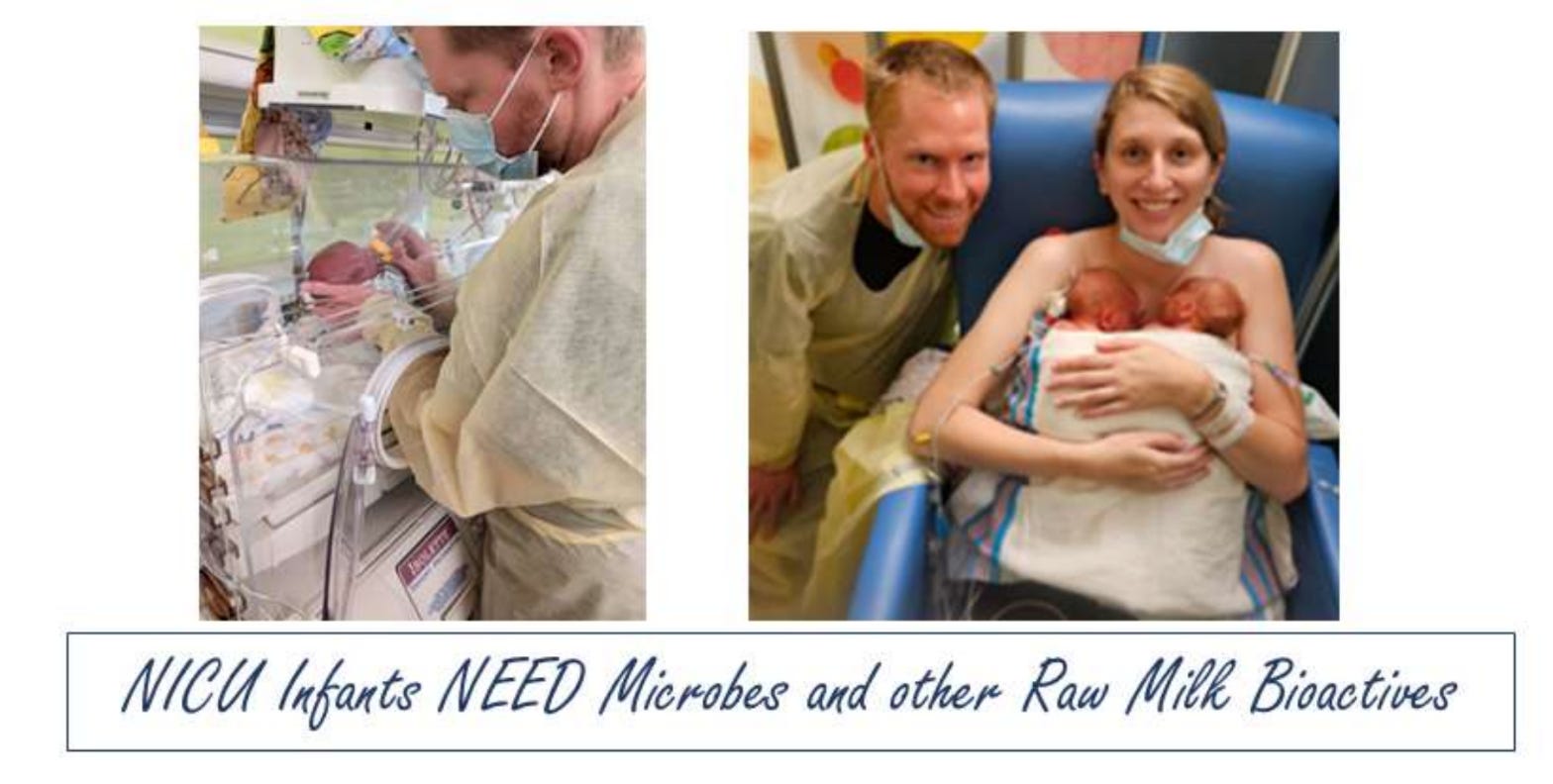
In these cases, breastmilk complete with its natural microbiota functions as an extraordinarily vital factor for ‘seeding and feeding’ our most vulnerable neonates (Sisk et al., 2016; Dietert, 2018; Davis et al., 2020; Boudry et al., 2021; van Goudoever et al., 2022; Meeus et al., 2024; Zhang et al., 2025). The living milk ecosystem helps protect against diseases of prematurity, including: bronchopulmonary dysplasia (BPD); late onset sepsis (LOS); necrotizing enterocolitis (NEC); and retinopathy of prematurity (ROP).
The problem with routine pasteurization of donor milk
Most human donor milk banks around the world, including the United States, pasteurize donor milk (Coleman et al., 2021). Pasteurization may reduce certain risks associated with particular pathogens, but it also destroys or degrades the heat-sensitive living microbiota and many other bioactive components of breastmilk that support infant development of healthy gut, immune, neural, and respiratory systems.
Norway offers a different model. For decades, Norwegian milk banks have successfully screened and provided unpasteurized donor breastmilk – intact, complete with its bioactive components including the milk microbiota – while maintaining strong safety records (Grøvslien & Grønn, 2009; Meltzer et al., 2013, 2016; Hård et al., 2019). The experience of Norweigan milk banks provides a practical benchmark for updating milk bank operations elsewhere so that neonates can receive the bioactives they need to thrive.
Nearly five years ago, Professor Dietert and colleagues mapped the evidence on benefits and risks of pasteurizing donor breastmilk using a transparent evidence-mapping approach (Coleman et al., 2021). The map displayed clear, convincing evidence of benefits from the intact (raw) milk ecosystem and limited rigorous evidence that universal pasteurization is required for carefully screened donors. The accompanying figure (green = evidence basis and supplemental studies; blue = benefits and risks; yellow = conclusions; and tan = remaining uncertainties) highlighted the need for deeper deliberation.
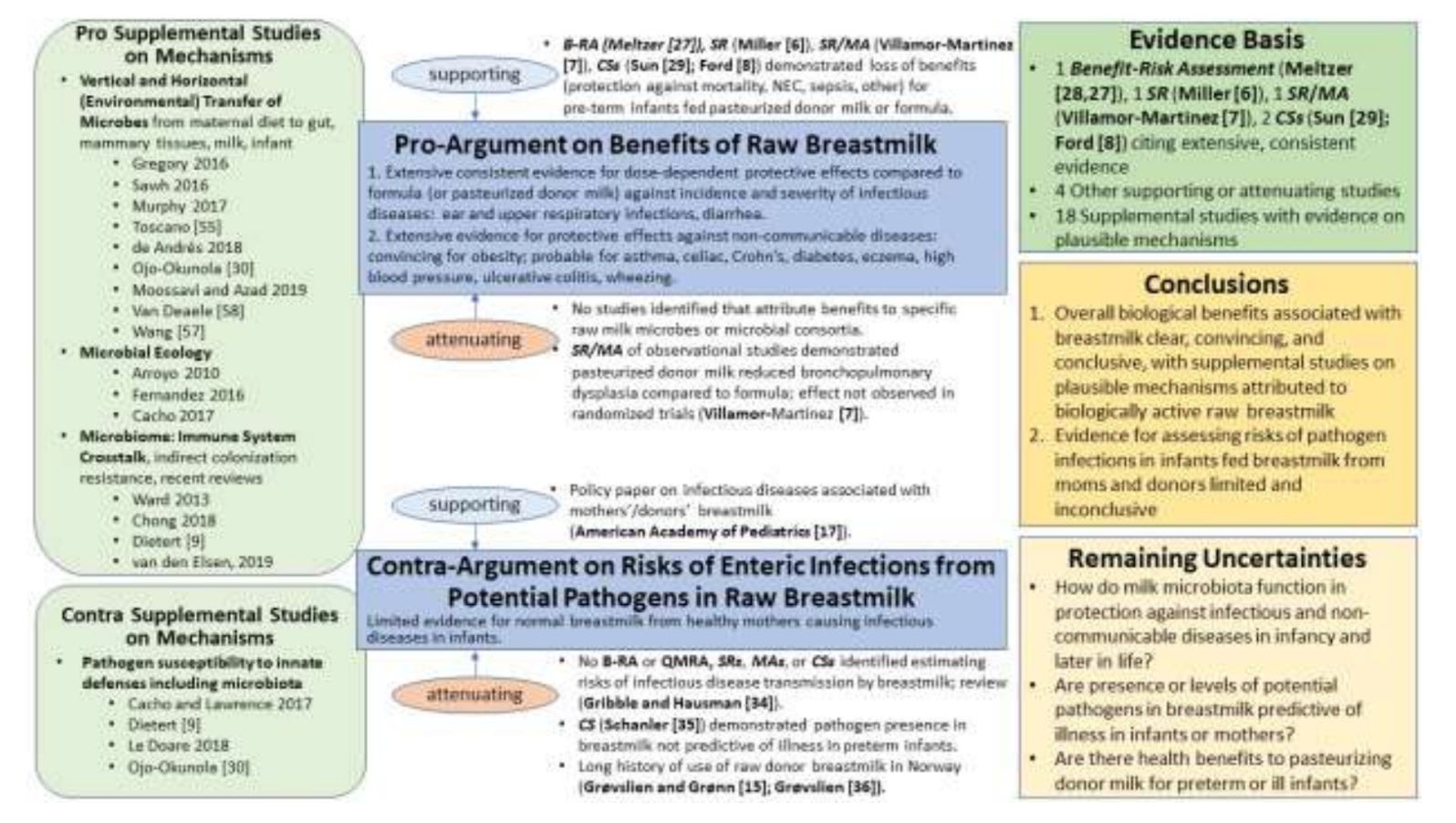
Since that evidence map was published, additional studies have reinforced the protective value of mother’s own milk and, by extension, the value of preserving the living milk ecosystem.
Reduced risk of BPD, associated with preserved bioactive defense components (Briere & Gomez, 2024)
Fewer days on ventilator and total parenteral nutrition; no increased mortality or morbidity for LOS, NEC, ROP; significant decrease in BPD; higher fat absorption and linear growth; no increase for infectious disease (Gomez et al., 2024)
Lower odds of BPD (Pütz et al., 2024)
Significantly higher survival rate without severe complications; lower incidence of BPD; faster weight gain; shorter time on full enteral feeding; less parenteral nutrition; no adverse effects or increased morbidity/mortality (Huang et al., 2023)
Positive correlation with weight, length, and head circumference scores; protection from ROP; more favorable growth (Lund et al., 2020)
Two other studies reported no statistically significant differences between mother’s own milk and unpasteurized and pasteurized donor breastmilk in certain cohorts (Karoobi et al., 2024; Xu et al., 2020). Even so, the overall pattern supports feeding mother’s own milk and carefully screening unpasteurized donor breastmilk as the preferred options for seeding and feeding the neonatal microbiome.
Need for a clearer hierarchy of feeding options
It is important not to blur distinctions, particularly when heat treatments are associated with loss of benefits to neonates. From a microbiome-first perspective, the evidence suggests the need for a practical and evidence-based ranking of feeding options for families of NICU infants.
A starting point for future deliberation follows:
breast feeding by mom or screened wetnurse;
mother’s own pumped milk (fresh preferred, refrigerated, frozen);
carefully screened unpasteurized donor breastmilk;
pasteurized donor breastmilk; and
formula.
Pasteurized donor milk retains some valuable human-specific components that formula lacks, and it remains far preferable to formula. Yet pasteurized donor milk has lost the living microbiota and many heat-sensitive bioactives present in fresh, carefully handled unpasteurized milk. Treating pasteurized donor milk and formula as roughly equivalent is misleading, understating the remaining value of pasteurized human milk components resistant to heat while also understating what is lost when we routinely destroy the milk microbiota and heat-sensitive bioactives.
What can we demand
Many of us are already willing to voice concerns about formula. The next step is to demand optimal feedings that truly seed and feed the neonatal gut microbiome – and to insist that families of NICU infants receive the Whole Truth about the downsides of routine pasteurization of donor milk.
Milk banks should offer parents the option of carefully screened unpasteurized donor milk alongside pasteurized donor milk. This is not a call for reckless practice; it is a call to update policy in light of evidence, Norway’s experience, and the microbiome-first principle that protects the most vulnerable infants.
You can take action today and make a small donation to the 2026 Whole Truth, Whole Milk Campaign via the embedded link or via the QR code.

The first goal of the campaign is to fully fund an independent panel peer-review of a case study based on currently available evidence of benefits and risks of pasteurizing breastmilk and bovine milk, using a transparent public process. The second goal is to formalize the impact of the lack of bioactives in formula for submission to a peer-reviewed journal. Your contribution to the campaign will help our team (Professor Dietert, decision science scholar D. Warner North, and me) bring greater credibility and clarity to public discourse about the health-promoting effects of the milk microbiota and other bioactives for breastmilk and cow’s milk.
Together, let’s challenge our long history of germophobia and misinformation about the milk microbiota and speak the Whole Truth about what is best for baby.
References
Abdullahi, A. M., Zhao, S., & Xu, Y. (2025). Efficacy of probiotic supplementation in preventing necrotizing enterocolitis in preterm infants: A systematic review and meta-analysis. The Journal of Maternal-Fetal & Neonatal Medicine: The Official Journal of the European Association of Perinatal Medicine, the Federation of Asia and Oceania Perinatal Societies, the International Society of Perinatal Obstetricians, 38(1), 2485215. https://doi.org/10.1080/14767058.2025.2485215
Boudry, G., Charton, E., Le Huerou-Luron, I., Ferret-Bernard, S., Le Gall, S., Even, S., & Blat, S. (2021). The relationship between breast milk components and the infant gut microbiota. Frontiers in Nutrition, 8, 629740. https://doi.org/10.3389/fnut.2021.629740.
Briere, C.-E., & Gomez, J. (2024). Fresh Parent’s Own Milk for Preterm Infants: Barriers and Future Opportunities. Nutrients, 16(3), Article 3. https://doi.org/10.3390/nu16030362
Calvo, L. N., Greenberg, R. G., & Gray, K. D. (2024). Safety and Effectiveness of Probiotics in Preterm Infants with Necrotizing Enterocolitis. NeoReviews, 25(4), e193–e206. https://doi.org/10.1542/neo.25-4-e193
Chitale, R., Ferguson, K., Talej, M., Yang, W.-C., He, S., Edmond, K. M., & Smith, E. R. (2022). Early Enteral Feeding for Preterm or Low Birth Weight Infants: A Systematic Review and Meta-analysis. Pediatrics, 150(Supplement 1), e2022057092E. https://doi.org/10.1542/peds.2022-057092E
Coleman, M. E., North, D. W., Dietert, R. R., & Stephenson, M. M. (2021). Examining Evidence of Benefits and Risks for Pasteurizing Donor Breastmilk. Applied Microbiology, 1(3), Article 3. https://doi.org/10.3390/applmicrobiol1030027
Coleman, M., Elkins, C., Gutting, B., Mongodin, E., Solano-Aguilar, G., & Walls, I. (2018). Microbiota and dose response: Evolving paradigm of health triangle. Risk Analysis, 38(10), 2013–2028.
Davis, J. A., Baumgartel, K., Morowitz, M. J., Giangrasso, V., & Demirci, J. R. (2020). The Role of Human Milk in Decreasing Necrotizing Enterocolitis Through Modulation of the Infant Gut Microbiome: A Scoping Review. Journal of Human Lactation, 36(4), 647–656. https://doi.org/10.1177/0890334420950260
Dietert, R. (2016). The human superorganism: How the microbiome is revolutionizing the pursuit of a healthy life. Dutton.
Dietert, R., & Dietert, J. (2024). Spirituality in the Realm of the Microbes. American Journal of Biomedical Science & Research, 22(1). https://doi.org/10.34297/AJBSR.2024.21.002927
Dietert, R. R. (2018). A focus on microbiome completeness and optimized colonization resistance in neonatology. NeoReviews, 19(2), e78–e88. https://doi.org/10.1542/neo.19-2-e78
Dietert, R. R. (2021). Microbiome first approaches to rescue public health and reduce human suffering. Biomedicines, 9(11), 1581. https://doi.org/10.3390/biomedicines9111581
Gomez, J. A., Abela, K., & LoBiondo-Wood, G. (2024). A Systemic Review of the Difference Between Diets for Preterm Infants Containing Raw Mother’s Own Milk and Frozen or Pasteurized Mother’s Own Milk. Journal of Human Lactation, 40(2), 259–269. https://doi.org/10.1177/08903344241227941
Grøvslien, A. H., & Grønn, M. (2009). Donor milk banking and breastfeeding in Norway. Journal of Human Lactation, 25(2), 206–210.
Hård, A.-L., Nilsson, A. K., Lund, A.-M., Hansen-Pupp, I., Smith, L. E. H., & Hellström, A. (2019). Review shows that donor milk does not promote the growth and development of preterm infants as well as maternal milk. Acta Paediatrica (Oslo, Norway: 1992), 108(6), 998–1007. https://doi.org/10.1111/apa.14702
Hodzic, Z., Bolock, A. M., & Good, M. (2017). The Role of Mucosal Immunity in the Pathogenesis of Necrotizing Enterocolitis. Frontiers in Pediatrics, 5. https://doi.org/10.3389/fped.2017.00040
Huang, J., Zheng, Z., Zhao, X., Huang, L., Wang, L., Zhang, X., & Lin, X. (2023). Short-term effects of fresh mother’s own milk in very preterm infants. Maternal & Child Nutrition, 19(1), e13430. https://doi.org/10.1111/mcn.13430
Karoobi, M., Azimi, A., Zarei, H., Saboute, M., Khalessi, N., & Vahedi, Z. (2024). Comparison of prematurity-related outcomes and complications in very low birth weight (VLBW) neonates fed with mother’s own milk versus donor milk: A comparative study. The Turkish Journal of Pediatrics, 66(1), 25–31. https://doi.org/10.24953/turkjped.2023.684
Kim, Y. C., Won, H. K., Lee, J. W., Sohn, K. H., Kim, M. H., Kim, T. B., Chang, Y. S., Lee, B. J., Cho, S. H., Bachert, C., & Song, W. J. (2019). Staphylococcus aureus Nasal Colonization and Asthma in Adults: Systematic Review and Meta-Analysis. J Allergy Clin Immunol Pract, 615(e9), Article e9. https://doi.org/10.1016/j.jaip.2018.08.020
Lund, A.-M., Löfqvist, C., Pivodic, A., Lundgren, P., Hård, A.-L., Hellström, A., & Hansen-Pupp, I. (2020). Unpasteurised maternal breast milk is positively associated with growth outcomes in extremely preterm infants. Acta Paediatrica, 109(6), 1138–1147. https://doi.org/10.1111/apa.15102
Makary, M. (2024). Blind Spots: When Medicine Gets It Wrong and What It Means for Our Health. Bloomsbury Publishing.
https://www.martymd.com/
Meeus, M., Beirnaert, C., Mahieu, L., Laukens, K., Meysman, P., Mulder, A., & Van Laere, D. (2024). Clinical Decision Support for Improved Neonatal Care: The Development of a Machine Learning Model for the Prediction of Late-onset Sepsis and Necrotizing Enterocolitis. The Journal of Pediatrics, 266, 113869. https://doi.org/10.1016/j.jpeds.2023.113869
Meltzer, H. M., Brandtzæg, P., Knutsen, H. K., Løland, B. F., Odland, J. Ø., Skåre, J. U., & Torheim, L. E. (2013). Benefit and risk assessment of breastmilk for infant health in Norway. Scientific opinion by the Scientific Steering Committee of VKM. Nydalen, Norway. https://vkm.no/download/18.2994e95b15cc5450716157e6/1501690194476/820a1a0bf8.pdf
Meltzer, H. M., Knutsen, H. K., Skåre, J. U., Brandtzæg, P., Torheim, L. E., Odland, J. Ø., & Løland, B. F. (2016). Benefit and risk assessment of breastmilk for infant health in Norway. https://doi.org/10.9734/EJNFS/2016/23233
Monzon, N., Kasahara, E. M., Gunasekaran, A., Burge, K. Y., & Chaaban, H. (2023). Impact of neonatal nutrition on necrotizing enterocolitis. Seminars in Pediatric Surgery, 32(3), 151305. https://doi.org/10.1016/j.sempedsurg.2023.151305
Pammi, M., Cope, J., Tarr, P. I., Warner, B. B., Morrow, A. L., Mai, V., Gregory, K. E., Kroll, J. S., McMurtry, V., Ferris, M. J., Engstrand, L., Lilja, H. E., Hollister, E. B., Versalovic, J., & Neu, J. (2017). Intestinal dysbiosis in preterm infants preceding necrotizing enterocolitis: A systematic review and meta-analysis. Microbiome, 5(1), 31. https://doi.org/10.1186/s40168-017-0248-8
Pütz, E., Ascherl, R., Wendt, T., Thome, U. H., Gebauer, C., Genuneit, J., & Siziba, L. P. (2024). The association of different types of human milk with bronchopulmonary dysplasia in preterm infants. Frontiers in Nutrition, 11. https://doi.org/10.3389/fnut.2024.1408033
Sisk, P. M., Lambeth, T. M., Rojas, M. A., Lightbourne, T., Barahona, M., Anthony, E., & Auringer, S. T. (2016). Necrotizing Enterocolitis and Growth in Preterm Infants Fed Predominantly Maternal Milk, Pasteurized Donor Milk, or Preterm Formula: A Retrospective Study. American Journal of Perinatology, 34, 676–683. https://doi.org/10.1055/s-0036-1597326
Thoene, M., & Anderson-Berry, A. (2021). Early Enteral Feeding in Preterm Infants: A Narrative Review of the Nutritional, Metabolic, and Developmental Benefits. Nutrients, 13(7), 2289. https://doi.org/10.3390/nu13072289
van Goudoever, J. B., Spatz, D. L., Hoban, R., Dumitriu, D., Gyamfi-Bannerman, C., Berns, M., McKechnie, L., & Davanzo, R. (2022). Updating Clinical Practices to Promote and Protect Human Milk and Breastfeeding in a COVID-19 Era. Frontiers in Pediatrics, 10, 867540. https://doi.org/10.3389/fped.2022.867540
Xu, Y., Yu, Z., Li, Q., Zhou, J., Yin, X., Ma, Y., Yin, Y., Jiang, S., Zhu, R., Wu, Y., Han, L., Gao, Y., Xue, M., Qiao, Y., Zhu, L., Tu, W., Wu, M., Wan, J., Wang, W., ... Han, S. (2020). Dose-dependent effect of human milk on Bronchopulmonary dysplasia in very low birth weight infants. BMC Pediatrics, 20(1), 522. https://doi.org/10.1186/s12887-020-02394-1
Zhang, D., Xie ,Dongke, Qu ,Yi, Mu ,Dezhi, & and Wang, S. (2025). Digging deeper into necrotizing enterocolitis: Bridging clinical, microbial, and molecular perspectives. Gut Microbes, 17(1), 2451071. https://doi.org/10.1080/19490976.2025.2451071